A message from Founder and Owner, Coach Tristan Mitchell:
Last month we talked about the importance of exercise to our longevity and quality of life, if you missed it you can check it out here! One point that we touched on was VO2 max and this month we’ll take a deeper dive into VO2 max – what it is, why it matters to our long-term health, and how to improve it.
First, what is VO2 max? Essentially it is a measurement that gives us insight into the size of our cardiovascular engine – how much oxygen can you inhale into your lungs, then get into your blood, and then to the muscle to be used for metabolic processes that provide your body with energy to move. VO2 max is measured using a device that attaches over your mouth and nose, then typically on either a bike or treadmill you will progress intensity up to a maximal effort. The device will measure the oxygen and CO2 coming into the body as you inhale and measure how much of each comes out as you exhale – obviously oxygen will go down and CO2 will go up and this will tell you how much oxygen is consumed. This measurement is usually done in liters (of oxygen) per minute and is then broken down by body weight to get milliliters per kilogram per minute, which gives you a VO2 max “score”. The higher the number the better.
Now, why does VO2 max matter for our health? Often VO2 max is tossed around as a topic amongst serious endurance athletes as a symbol of their output capacity (although there are limits to how predictive of high end performance it is) but VO2 max matters for our long term health in a unique way. The higher your VO2 max and better your cardiorespiratory fitness, the lower your all-cause mortality risk is. This correlation holds true even amongst the already fit crowd – the more that number goes up the better.
What does this mean for you? Well in my opinion it means that we all should be doing some form of training that increases our VO2 max. No matter your age you can benefit from this form of training to increase, or at least slow down the decline, of your VO2 max as you age. The younger you are the more aggressively you should tackle this form of training because the higher you can get your VO2 max in your physical prime the better you can buffer age related decline.
We have talked about zone 2 training in past Pride editions - zone 2, or training your aerobic efficiency, is the base in which your cardiovascular fitness is built upon. VO2 max work is training the peak of the pyramid on top that aerobic base. So how do we best train VO2 max? There are many ways to help increase your VO2 max, popular approaches tend to be things like Tabata intervals - 20 seconds of a very hard effort followed by 10sec down, repeated for 8 rounds, or 4 minutes. This is undoubtedly a time effective way to benefit your VO2 max but isn’t necessarily the “best” to do so.
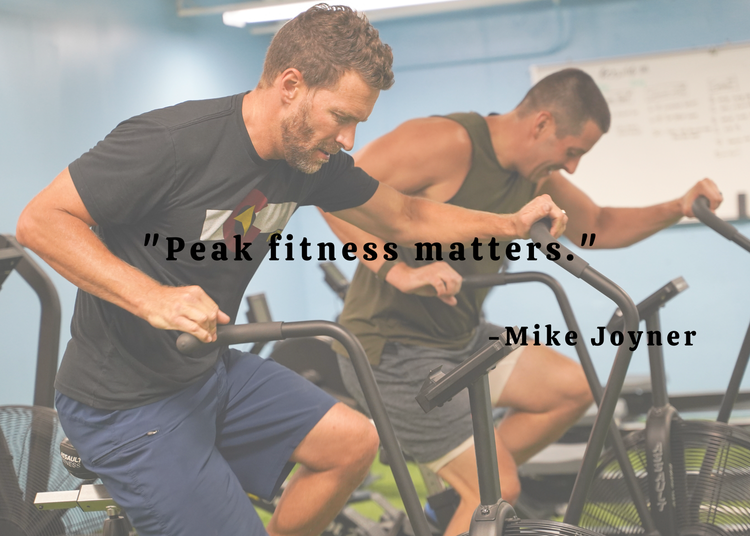
The best way to increase VO2 max is to do 4-6 minute intervals with equal time down in between and repeated 4 or more times. Runners working towards getting faster will often do training sessions that will help increase VO2 max even though they may not necessarily be thinking about it in exactly those terms - this may look like 1 kilometer to 1 mile repeats. That being said, this isn’t a form of training that needs to be or should be reserved for runners. Anyone can implement these intervals into their routine in whatever form of cardiovascular training they prefer - meaning you can do these on a rower, a bike, swimming, cross-country skiing, or anything else, just as easily as running.
The way to approach this kind of work is that the first interval is a hard effort but not flat out, as you progress through the 4 sets you will try to maintain the effort or slightly increase the effort each round. After each interval you will take an equal amount of time down, either by continuing to move at a very easy effort and/or completely resting. As each interval goes by the efforts become more and more difficult to maintain and by the end of the last interval you should be basically all-out at the finish. This type of training would be performed at least once a week and ideally twice.
VO2 max work is not just for competitive athletes but for anyone who cares about improving their overall health, performance, and longevity. If you have any questions on how to start including VO2 max training into your training regime reach out to us today!